



Partners


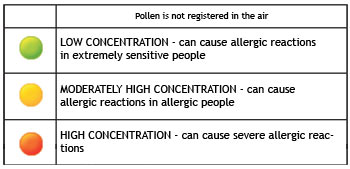
Allergy stoplights
-
Concentration of pollen in the air from 21 plant types is monitored from the beginning of February until the first days of November including the tree flowering season (February to May), grass/weed (May to July) and weed (July to November). An allergy stoplight is a way of daily reporting about the quantity of pollen grains in the air above a certain area which usually appears in the newspaper or in the media.
Colours of the allergy stoplight are determined based on the measuring of the quantity of pollen grains in a cubic meter of atmospheric air:
- Green stands for the concentration of pollen in the air which can cause allergic symptoms in a very small number of hypersensitive people.
- Yellow stands for concentration pollen which causes symptoms in most allergic people.
- Red stands for very high concentration of pollen which will cause symptoms in all sensitive persons and the symptoms may be severe in hypersensitive persons.
The results are shown as an allergy stoplight: up to 30 grains in a cubic meter of air is green light, from 30 to 60 is yellow, 60 and more is red. The exception is ambrosia, so the three stoplight values for it are 0-15, 16-30 and more than 30 grains.
Life cycle of ambrosia
The area of ambrosia expansion is open type vegetation in the first place, which dominates the Pannonian Plain. It is a thermophilic species, the sneezing starts when the soil warms up and it lasts until the end of June, even though in some ruderal sites it germinates and sprouts until September. It possesses great reproductive potential and a constant supply of seeds in the soil which in fact complicates and raises the cost of its suppression. Ambrosia plant seedling has wide elliptical cotyledon. The first few seedling leaves are wide and egg-like, feather-like divided, with short hairs. Ambrosia flourishes from July to September. Adult ambrosia plant branches from the ground plant and is densely covered with feather-like divided leaves. In the reproductive stage it is covered in many heads grouped together in racemose inflorescence. The research has so far shown that ambrosia is especially dangerous in the flourishing stage, that is, from July to October. The weather in this time period is very hot and dry which is favourable for the plant and in those conditions it reaches its maximum pollen production in the air which causes allergic reactions. Ambrosia fruit is of achenium type, egg-like with five to seven spikes, one of the spikes - the central one - is the longest. One ambrosia plant produces 500-3000 achenium which can hold the germination in the soil for a long time.
POLLEN CALENDAR
Pollen calendar shows the presence of plant pollen in the air of a certain area. The main purpose of the calendar is to inform about the appearance of some seasonal allergens, which provides patients with the opportunity to adapt their activities and therefore be less in touch with the allergens. Making of pollen calendars is based on perennial monitoring and can show daily, weekly or ten day periods of fluctuations of average daily pollen concentration suspended in the air.
POLLEN ALLERGY CALENDAR
Tree pollen - March, April
Grass pollen - from May to July, sometimes until the end of August
Weed pollen - from the end of July until October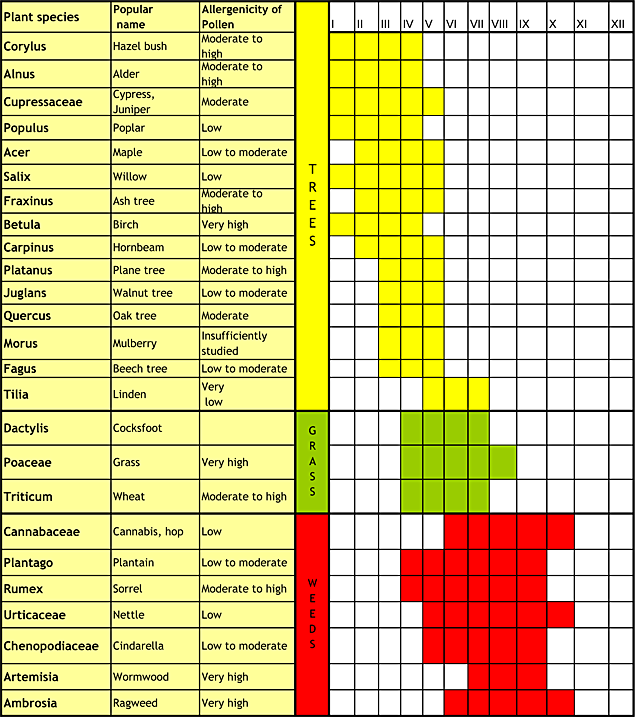
 This website has been produced with the financial assistance of the European Union. The content of the website is the sole responsibility of the European Affairs Fund of Autonomous Province of Vojvodina and can under no circumstances be regarded as reflecting the position of the European Union and/or the Managing Authority.